Institutional Assessment and Accreditation
The Office of Institutional Assessment and Accreditation provides leadership and direction for all college-wide planning, assessment, compliance, and research activities to ensure continuous improvement, growth, and accreditation compliance with the Southern Association of Colleges and Schools Commission on Colleges (SACSCOC). The division provides institutional and programmatic research to report to various state and federal agencies. Assessment at Robeson Community College is a systematic, integrated, and ongoing process of planning and assessing institutional performance through regular: review of the college’s mission, goals, and outcomes; evaluation of programs and services; assessment of outcomes across all institutional units; and use of data and assessment results to inform decision-making.
Lynn Criswell, Director of Institutional Assessment, Accreditation, and Special Projects, provides training on planning and assessment, administers institutional surveys for assessment purposes, monitors reporting for data quality, produces reports to inform the college community of the state of the college, coordinates the program review process, monitors key performance indicators to ensure effectiveness, and provides institutional research support to all departments.
Dr. LaRonda Lowery, Assistant Vice President of Instruction and Student Support Services, serves as the Southern Association of Colleges and Schools Commission on Colleges (SACSCOC) accreditation liaison for the college and is also designated as the college’s data coordinator and the IPEDS (Integrated Postsecondary Education Data System) key holder.
Robeson Community College is committed to the continuous improvement and growth of its programs and services to increase student success and institutional quality.
The purpose of the Institutional Assessment and Accreditation website is to: provide commonly used data in an easily accessible form; disseminate focused reports intended to enrich our collective understanding of the effectiveness process; and facilitate the department’s mission – to support institutional planning, decision-making, and continuous improvement through a comprehensive, integrated program of assessment, evaluation, growth strategies, and research.
Robeson Community College employees may submit a Campus Research Request here.
For more information, please get in touch with Dr. LaRonda Lowery at 910-272-3305 or lalowery@robeson.edu
Robeson Community College is accredited by the Southern Association of Colleges and Schools Commission on Colleges (SACSCOC) to award associate degrees. Robeson Community College may also offer credentials such as certificates and diplomas at approved degree levels. Questions about the accreditation of Robeson Community College may be directed in writing to the Southern Association of Colleges and Schools Commission on Colleges at 1866 Southern Lane, Decatur, GA 30033-4097, by calling (404) 679-4500, or by using information available on SACSCOC’s website (www.sacscoc.org).
The US Secretary of Education recognizes accreditation by the Southern Association of Colleges and Schools Commission on Colleges (SACSCOC) in establishing the eligibility of higher education institutions to participate in federal funding. Accreditation allows us to receive federal funding and provide financial aid to our students. As an accredited institution, our degrees are recognized by receiving institutions, which allows our courses to articulate to other colleges and universities.
RCC was initially accredited in 1975 by SACSCOC and was reaffirmed for accreditation in 2020. Accreditation by SACSCOC signifies that an institution meets standards established by the higher education community that address the needs of society and students, has a purpose appropriate to higher education, and has the resources, programs, and services sufficient to accomplish its purpose on a continuing basis. Accreditation evaluates whether an institution maintains clearly specified educational objectives consistent with its mission and whether it is successful in achieving its stated objectives. The Commission has been a leader in defining and implementing the concept of “institutional effectiveness” in higher education and is known for having stringent requirements for membership.
The Southern Association of Colleges and Schools Commission on Colleges (SACSCOC) is one of six private, nonprofit, regional accrediting associations recognized by the Department of Education. SACSCOC was founded in 1895 for the purpose of improving education in colleges and schools. SACSCOC accredits institutions of higher education in eleven southern states (Alabama, Florida, Georgia, Kentucky, Louisiana, Mississippi, North Carolina, South Carolina, Tennessee, Texas, and Virginia) and Latin America that award associate, baccalaureate, master’s, or doctoral degrees.
For a copy of the Principles of Accreditation: Foundation for Quality Enhancement or for more information about the Southern Association of Colleges and Schools, Commission on Colleges and accreditation, please visit the SACSCOC website.
ACCREDITATIONS AND CERTIFICATIONS OF SELECT PROGRAMS
Associate Degree Nursing Program
The Robeson Community College Associate Degree Nursing Program holds national CNEA accreditation status from the National League for Nursing Commission for Nursing Education Accreditation, located at 2600 Virginia Avenue, NW, Washington, DC, 20037.
The Associate Degree Nursing Program is approved by the North Carolina Board of Nursing (NCBON).
North Carolina Board of Nursing [opens in a new tab]
www.ncbon.com
P.O. Box 2129
Raleigh, NC 27602-2129
919-782-3211
Barbering Program
The Barbering Program is approved by the North Carolina Board of Barber Examiners.
North Carolina Board of Barber Examiners
www.ncbarbers.com
5809 Departure Drive
Suite 102
Raleigh, NC 27616
919-981-5210
Basic Law Enforcement Training Program
The Basic Law Enforcement Training Program is accredited by the North Carolina Department of Justice, Criminal Justice Education and Training Standards Commission, and the North Carolina Sheriffs’ Education and Training Standards Commission.
Criminal Justice Education and Training Standards Division
https://ncdoj.gov/law-enforcement-training/criminal-justice/
P.O. Drawer 149
Raleigh, NC 27602
919-661-5980
North Carolina Sheriffs’ Education and Training Standards Division
https://ncdoj.gov/law-enforcement-training/sheriffs
P. O. Box 629
Raleigh, NC 27602
919-779-8213
Cosmetology Program
The Cosmetology Program is approved by the North Carolina State Board of Cosmetic Arts.
North Carolina Board of Cosmetic Arts
www.nccosmeticarts.com
1207 Front Street
Suite 110
Raleigh, NC 27609
919-733-4117
Emergency Medical Science Program
The Robeson Community College Paramedic program is accredited by the Committee on Accreditation of Allied Health Programs (www.caahep.org) upon the recommendation of the Committee on Accreditation of Educational Programs for the Emergency Medical Services Professions (CoAEMSP).
Program Goals:
“To prepare Paramedics who are competent in the cognitive (knowledge), psychomotor (skills), and affective (Behavior) learning domains to enter the profession.”
Commission on Accreditation of Allied Health Education Programs
9355 – 113th St. N
#7709
Seminole, FL 33775
(727) 210-2350
www.caahep.org
2023 Annual Report Statistics
NREMT/State Written Exam: 86.7%
Retention: 40.5%
Positive (Job) Placement: 86.7%
To contact CoAEMSP:
8301 Lakeview Parkway
Suite 111-312
Rowlett, TX 75088
214-703-8445
FAX 214-703-8992
http://www.coaemsp.org
Medical Sonography
The Medical Sonography Program is accredited by the Commission on Accreditation of Allied Health Education Programs (CAAHEP) upon the recommendation of the Joint Review Committee on Education in Diagnostic Medical Sonography (JRC-DMS).
Commission on Accreditation of Allied Health Education Programs
9355 – 113th St. N
#7709
Seminole, FL 33775
(727) 210-2350
www.caahep.org
Joint Review Committee on Education in Diagnostic Medical Sonography
6021 University Boulevard
Suite 500
Ellicott City, MD 21043
(443) 973-3251
www.jrcdms.org
Nurse Aide Program
The Nurse Aide Program is approved by the North Carolina Department of Health and Human Services, Division of Health Regulation, Health Care Personnel Registry Section, Center for Aide and Education (CARE).
Center for Aide Regulation and Education
2709 Mail Service Center
Raleigh, NC 27699-2709
919-855-3969
Practical Nursing Program
The Practical Nursing Program is approved by the North Carolina Board of Nursing (NCBON).
North Carolina Board of Nursing
P.O. Box 2129
Raleigh, NC 27602-2129
http://www.ncbon.com
919-782-3211
Radiography Program
The Radiography Program is accredited by Joint Review Committee on Education in Radiologic Technology (JRCERT).
Joint Review Committee on Education in Radiologic Technology
20 North Wacker Drive
Suite 2850
Chicago, IL 60606-3182
http://www.jrcert.org
312-704-5300
Respiratory Therapy Program
The Respiratory Therapy Program is accredited by the Commission on Accreditation for Respiratory Care (CoARC).
Commission on Accreditation for Respiratory Care
264 Precision Blvd
Telford, TN 37690
http://www.coarc.com
817-283-2835
Surgical Technology Program
The Surgical Technology Program is accredited by the Commission on Accreditation of Allied Health Education Programs (CAAHEP) upon the recommendation of the Accreditation Review Council on Education in Surgical Technology and Surgical Assisting (ARC/STSA).
Commission on Accreditation of Allied Health Education Programs
9355 113th St. N
#7709
Seminole, FL 33775
http://www.caahep.org
727-210-2350
Accreditation Review Council on Education in Surgical Technology and Surgical Assisting
19751 E. Mainstreet
Suite #339
Parker, CO 80138
http://www.arcstsa.org
303-694-9262
The Performance Measures for Student Success Report is the North Carolina Community College System’s major accountability document. This annual performance report is based on data compiled from the previous year and serves to inform colleges and the public on the performance of our 58 community colleges.
In 1993, the State Board of Community Colleges began monitoring performance data on specific measures to ensure public accountability for programs and services. In 1998, the General Assembly directed the State Board to review past performance measures and define standards to ensure programs and services offered by community colleges in North Carolina were of sufficient quality.
In 2010, a review process was established to ensure the measures and methods for evaluating colleges were current and remained focused on improving student success. Every three years, a committee that is inclusive of college leaders, subject matter experts, and research and assessment professionals is appointed to review the measures and recommend deletions, revisions, and additions. Recommendations from the most recent review were approved in 2018.
The current list of measures includes:
- Basic Skills Student Progress
- Student Success Rate in College‐Level English Courses
- Student Success Rate in College‐Level Math Courses
- First Year Progression
- Curriculum Student Completion
- Licensure and Certification Passing Rate
- College Transfer Performance
Complete details for all 58 North Carolina Community Colleges can be found at the NCCCS Website. Additionally, a series of SAS-powered dashboards provides a visual depiction of the Performance Measures along with the ability to compare Community Colleges.
Part A – NCCCS Performance Measures
The Performance Measures for Student Success Report is the North Carolina Community College System’s major accountability document. This annual performance report is based on data compiled from the previous year and serves to inform colleges and the public on the performance of our 58 community colleges.
Part B – Robeson Community College Student Achievement Indicators
Thresholds are Robeson Community College’s student achievement indicators in the areas of progression, completion, pre-college success, and general education.
MISSION STATEMENT
Robeson Community College ignites a vibrant learning environment where academic, technical, and real-world experiences intersect and creates a culture of success driven by relentless inquiry, tangible results, and a profound commitment to excellence.
VISION STATEMENT
Robeson Community College is celebrated as a premier academic and career technical institution, transforming lives through unparalleled teaching, dynamic learning experiences, and an unwavering dedication to service.
WE SUCCEED THROUGH
- Academic Excellence, with expert faculty utilizing innovative teaching strategies and state-of-the-art technology to prepare students to compete in a future-focused workforce
- Empowered Support, prioritizing services meeting individualized student needs, encouraging self-advocacy, and connecting learners more deeply within the college, community, and workforce
- Innovation, cultivating programs to align with emerging industry needs and workforce demands, while scheduling with the flexibility to accommodate students’ lives
- Integrity through honest, compassionate, and responsive interactions with all stakeholders
- Growth, expanding partnerships, programming, service locations, technology, and opportunities based on data-informed decisions to serve the diverse needs of all citizens and learners
- Professional Development actively promotes skill enhancement among faculty and staff to provide expert leadership and growth opportunities in an evolving educational environment
Strategic Plan 2024-29
Quality Enhancement Plan (QEP)
SPARC (Success – Progression – Achieve – Retention – Completion) is a Quality Enhancement Plan (QEP) that grew out of RCC’s retention needs and will provide additional opportunities for growth. RCC developed the QEP topic through a parallel planning process that included faculty and staff input as well as institutional data.
Starting with a beta testing phase in Fall 2019 and leading to full implementation in Fall 2020, the goal is to improve progression, retention, and completion of students enrolled in targeted courses. Faculty will partner with success coaches to positively impact student success.
The launch of Aviso, an early alert system, in late Fall 2019, is further expected to contribute to increased student success. Aviso prioritizes students at risk, identifies intervention opportunities, and quickly informs faculty and success coaches.
IPEDS Reports
The Integrated Postsecondary Education Data System (IPEDS), established as the core postsecondary education data collection program for the National Center for Education Statistics (NCES), is a system of surveys designed to collect data from all primary providers of postsecondary education. IPEDS is a single, comprehensive system designed to encompass all institutions and educational organizations whose primary purpose is to provide postsecondary education. The IPEDS system is built around a series of interrelated surveys to collect institution-level data in such areas as enrollment, program completion, faculty, staff, and finances (Source: National Center for Education Statistics)
Integrated Postsecondary Education Data System College Navigator Report for RCC (IPEDS)
Academic Program Offerings With CIP Codes
The Classification of Instructional Programs (CIP) provides a taxonomic scheme that supports the accurate tracking and reporting of fields of study and program completions activity. CIP was originally developed by the U.S. Department of Education’s National Center for Education Statistics (NCES) in 1980, with revisions occurring in 1985, 1990, 2000, 2010, and 2020. Information on the 1985, 1990, 2000, and 2010 CIP can be accessed on the resources page under the section heading Archive and Historical.
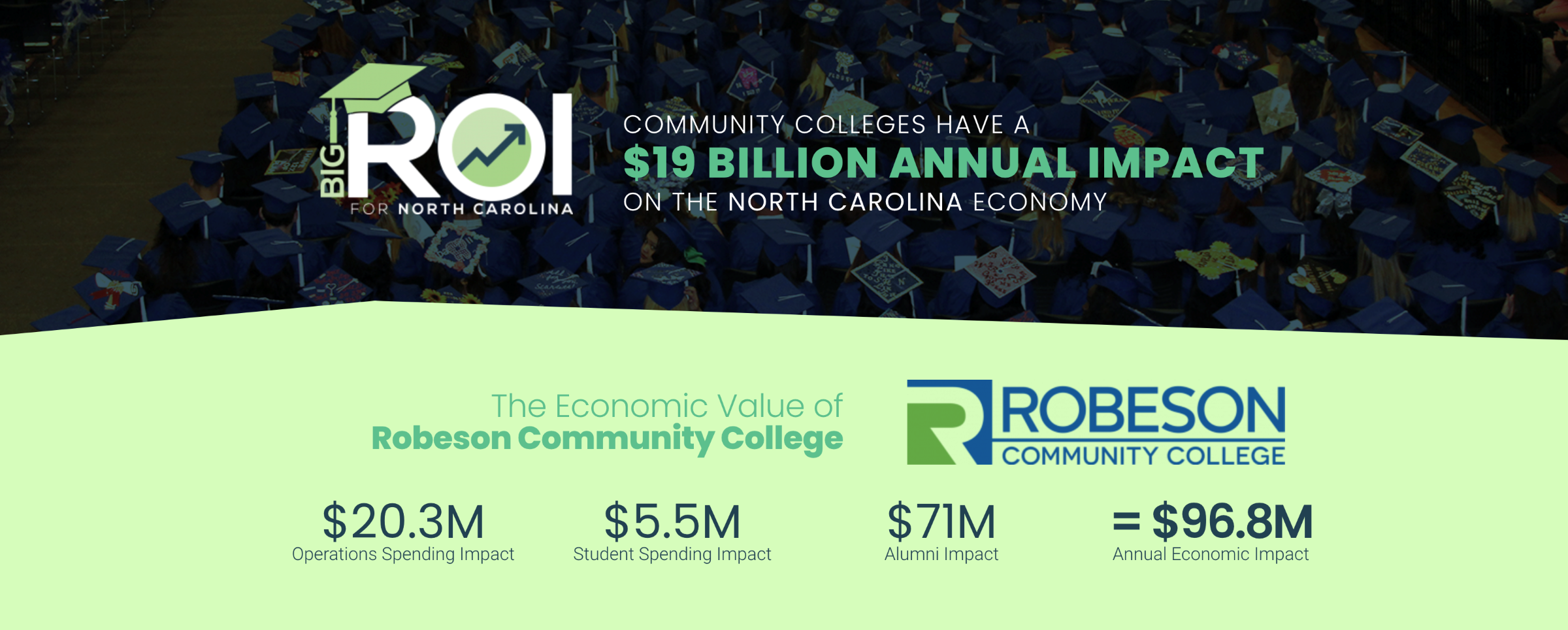
The Economic Value of Robeson Community College
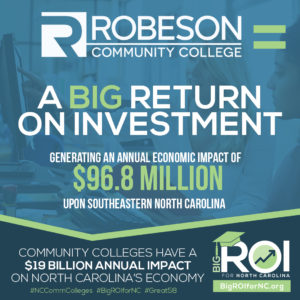
ROBESON COMMUNITY COLLEGE (RCC) creates value in many ways. The college plays a key role in helping students increase their employability and achieve their individual potential. The college draws students to the region, generating new dollars and opportunities for Southeastern North Carolina. RCC provides students with the education, training, and skills they need to have fulfilling and prosperous careers. Furthermore, RCC is a place for students to meet new people, increase their self-confidence, and promote their overall health and well-being.
RCC influences both the lives of its students and the regional economy. The college supports a variety of industries in Southeastern North Carolina, serves regional businesses, and benefits society as a whole in North Carolina from an expanded economy and improved quality of life. Additionally, the benefits created by RCC extend to the state and local government through increased tax revenues and public sector savings.
This study measures the economic impacts created by RCC on the business community and the benefits the college generates in return for the investments made by its key stakeholder groups—students, taxpayers, and society.
U.S. Department of Education College Scorecard
The College Scorecard is a US Department of Education data initiative providing transparency and consumer information related to individual institutions of higher education and individual fields of study within those institutions. College Scorecard brings together information on postsecondary costs, graduation rates, student loan debt, post-college earnings, and more.
EdNC Community College Profile
EducationNC (EdNC) works to expand educational opportunities for all students in North Carolina, increase their academic attainment, and improve the performance of the state’s public schools and colleges. EdNC provides residents and policymakers with nonpartisan data, research, news, information, and analysis about the major trends, issues, and challenges bearing on education.
NC Community Colleges State Performance Measures Dashboard
NC Community Colleges State Performance Measures Dashboard is a series of SAS-powered dashboards that provide a visual depiction of the Performance Measures along with the ability to compare Community Colleges.
Robeson County US Census Reporter Profile
Census Reporter is an independent project to make it easier for journalists to write stories using information from the U.S. Census Bureau. Place profiles and comparison pages provide a friendly interface for navigating data, including visualizations for a more useful first look.
NC Department of Commerce – Access NC Robeson County Profile
The mission of the North Carolina Department of Commerce is to improve the economic well-being and quality of life for all North Carolinians. To do that, the North Carolina Department of Commerce works closely with local, regional, national, and international organizations to propel economic, community, and workforce development for the state.
NC Department of Commerce – Access NC Robeson County Profile
Some College, No Credential Student Outcomes Annual Progress Report – Academic Year 2020/21
The Some College, No Credential (SCNC) report series seeks to understand the educational trajectories of millions of U.S. adults who left postsecondary education without receiving a postsecondary credential and are no longer enrolled. As the third in the series, this report identifies the levels of opportunity within each state for re-engaging SCNC students in the postsecondary attainment pipeline by tracking SCNC student outcomes annually: “Re-Enrollment” after stop-out, completion of “First Credential,” and “Perseverance” as indicated by continuous enrollment beyond first re-enrollment.
Highlights
- The number of SCNC students rose to 39 million as of July 2020. Forty-eight states and D.C. experienced a net growth.
- California, Texas, New York, and Illinois account for more than a third of the nation’s SCNC students. However, Alaska shows the largest number of SCNC students per 1,000 currently enrolled undergraduates among all states.
- During the academic year 2020/21, 944,200 SCNC students re-enrolled and 60,400 students earned their first-ever postsecondary credential. An additional 531,700 students were still enrolled after re-enrolling the previous year. (These outcomes reference SCNC students aged 18 to 64.)
- About 62 percent of the 944,200 students changed institutions upon re-enrolling, and those who did change institutions also commonly crossed institution sectors (67%). Re-enrolling in a community college after last attending a community college was the most common pathway for SCNC re-enrollees (363,400 students, 38.5%).
- Seventy percent of the 60,400 completers obtained their credential from a public institution (two- or four-year). Private nonprofit four-year institutions had the highest perseverance rates (64.8%), while community colleges had the lowest (50.2%).
- Women outnumbered men in re-enrollment, credential earning, and perseverance. The share of re-enrollees among minority women was substantially higher than men (63.5% versus 34.6%).
- Associate degrees were the most common credential earned by Latinx SCNC students (42.5%), whereas Black students were most likely to have completed a certificate (42.7%). Asian and White students persevered at a higher rate than other groups.
2023 President’s Annual Report
Topics included in the report:
- Veterans’ Wall Unveiled
- RCC Hosts District 7 AISES Conference
- Visit from Miss North Carolina USA and Miss Teen North Carolina USA
- Strategic Initiatives
- Student Success Stories
- Articulations Agreements signed in 2023-2024
- Foundation Highlights
- Academic and Technical Program Highlights
- Grants/Sponsored Projects
- Cultural Events
- Faculty/Staff Highlights
- Financial Report
- Special Profile of President Melissa Singler
- Summer 2023 – Spring 2024 Data for Curriculum and Continuing Education Programs
…. and more!
To download a copy of the report, please click here.
About RCC
Accreditation
Mission & Values
Board of Trustees
Foundation
History
Jobs at RCC
Fast Facts
Admissions
A to Z Program List
Career & College Promise
Health Science Admission Packets
Residency Determination
New Student Orientation
Placement Testing
Transcript Request
Downloads
Public Disclosure
College Navigator
Report a Concern
Student Achievement
Notice of Non-Discrimination Policy